
Total cost
Annual premium, deductible, copays, coinsurance, drug costs, and the in-network out-of-pocket limit.
Plan comparison · State routes · Practical worksheets
A privacy-first, document-based method for comparing live U.S. plan options—without fake quotes, universal rankings, or hidden availability claims.
There is no honest, permanent chart of every health insurance plan in the United States. The available menu changes by state, county or ZIP code, household, enrollment timing, and plan year. HealthCoverUSA gives you a repeatable method for comparing the live plans that actually appear for you.
Start with the correct official Marketplace. Then compare exact plan documents—not brand reputation alone—across total cost, provider access, prescriptions, plan rules, and financial protection.

Five checks, one decision record
A low premium can be useful, but it is only one line in the plan. Use the same evidence for every candidate.
Annual premium, deductible, copays, coinsurance, drug costs, and the in-network out-of-pocket limit.
Exact doctors, hospitals, laboratories, pharmacies, network rules, and out-of-area coverage.
Formulary status, tier, quantity limits, prior authorization, step therapy, and pharmacy network.
Summary of Benefits and Coverage, exclusions, evidence of coverage, and a plan-year identifier.
The official Marketplace for income-based savings; separate official routes for Medicaid, CHIP, and Medicare.
Referral requirements, preauthorization, emergency rules, and the process for appeals or exceptions.
Network comparison
These labels are useful starting points, not substitutes for the plan's actual documents.
| Type | Typical network design | Specialist referrals | Non-emergency out-of-network care |
|---|---|---|---|
| HMO | Usually a defined local network | Often required for specialists | Usually emergencies only |
| PPO | Preferred network with broader choice | Usually not required | Often covered at a higher member cost |
| EPO | Exclusive participating network | Often not required | Usually emergencies only |
| POS | Network plus primary-care coordination | Often required | May be covered at a higher member cost |
High-value research paths
Use the eight-step method and keep exact plan identifiers. Comparison guide.
Bronze, Silver, Gold, and Platinum describe cost sharing—not care quality. Metal guide.
See why either number alone can hide the real tradeoff. Cost guide.
Use the current CMS 2026 Marketplace classification. State directory.
Use public official previews before creating an account or contacting a seller. Privacy-first route.
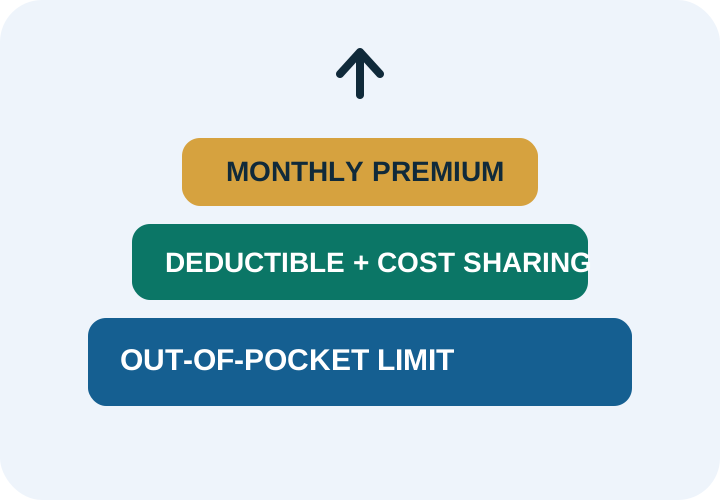
Use monthly premium and the in-network out-of-pocket limit to create a plan-year boundary. Open worksheet.
Free, local tool
Enter plan figures in your browser, compare the premium floor with a simple in-network cost boundary, then print or save the worksheet. It is arithmetic based on your plan documents—not a quote or prediction.
Common comparison decisions
These paths connect broad research to a specific, verifiable task.
A low premium can help, but affordability depends on the full plan, the household, official savings, and the care that must remain accessible.
The useful answer is not one national winner. It is the plan that survives the household's documented access, cost, prescription, and protection checks.
Monthly premium is only the entry price. A useful comparison separates predictable cost, care-dependent cost, and exposure outside the plan's protected boundary.
Start by identifying the market, legal issuer, coverage year, benefits, exclusions, and plan documents. Similar marketing labels do not make products equivalent.
Use the newly published official Marketplace route and current plan-year records. Recheck every plan instead of carrying a 2026 name, network, premium, or benefit forward.
Verification links
Primary sources checked August 11, 2026.