
Routine and preventive care
Primary-care copays, preventive-service rules, lab and imaging charges, referrals, and telehealth terms.
Benefit-by-benefit comparison
Align plan records, then compare routine care, prescriptions, diagnostics, hospital services, access rules, and financial protection.
“Medical insurance” and “health insurance” are often used interchangeably, but a useful comparison must go beyond the label. Begin with the current SBC for each plan, align the coverage period and plan ID, and compare the same medical services in the same order.
This guide is organized around care pathways: routine outpatient care, prescriptions, diagnostic services, hospital care, behavioral health, maternity and newborn care, rehabilitation, and urgent or emergency care. The benefit details—not a marketing summary—show how the plan handles each path.
SBC-first workflow
Primary-care copays, preventive-service rules, lab and imaging charges, referrals, and telehealth terms.
Separate drug deductible, formulary tier, preferred pharmacy, mail order, prior authorization, and step therapy.
Urgent care, emergency facility and physician charges, ambulance, observation, and post-stabilization network rules.
Facility versus professional charges, deductible timing, per-day or per-stay terms, and authorization requirements.
Outpatient visits, inpatient services, network access, telehealth, and any authorization rules shown in plan records.
Visit limits, habilitation versus rehabilitation, therapy disciplines, equipment, and medical-necessity rules.
Document stack
| Record | Useful for | Important limit |
|---|---|---|
| Summary of Benefits and Coverage | Standardized overview of major benefits, cost sharing, exclusions, and coverage examples | Not every service, provider, or drug detail appears |
| Provider directory | Doctors, hospitals, facilities, pharmacies, and service area for the network | Directories can change; confirm important providers directly |
| Drug formulary | Covered drugs, tiers, restrictions, and pharmacy rules | Match exact drug, dose, form, plan, and year |
| Evidence of coverage or policy | Detailed rules, definitions, exclusions, claims, authorization, and appeals | Longer document; search by the service or term you need |
| Live Marketplace result | Plans and net premiums shown for the submitted household facts | Results are time-, location-, and application-specific |
Final check
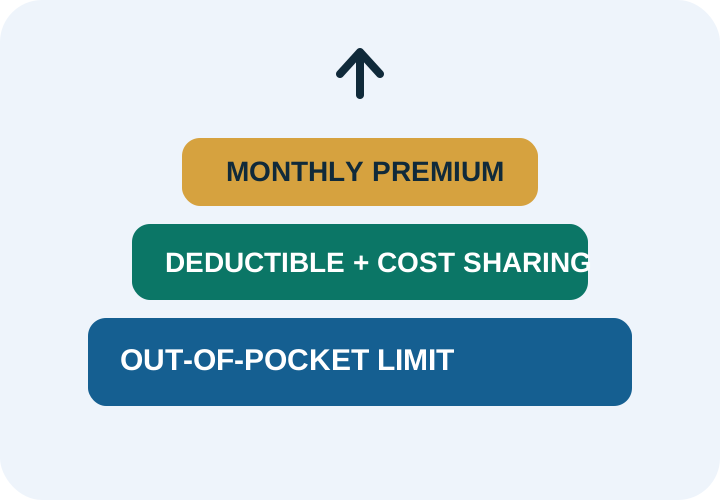
A medically comprehensive benefit list is not enough if the plan's network does not provide practical access. A broad network can still be expensive if recurring services have high cost sharing. A low premium can remain a reasonable choice for some households, but only after comparing the deductible, service-level charges, prescriptions, and the in-network out-of-pocket limit.
Write down unresolved questions and ask the Marketplace, employer plan administrator, or insurer for the controlling document. Keep the answer with the plan name, ID, and date. HealthCoverUSA does not interpret a policy for an individual or confirm that a service will be paid.
Verification links